How Much Does a Building Permit Cost? Fees & Factors (2026)
· By DTF Metal Buildings · Tips & Guides
How Much Does a Building Permit Cost? Fees & Factors (2026)
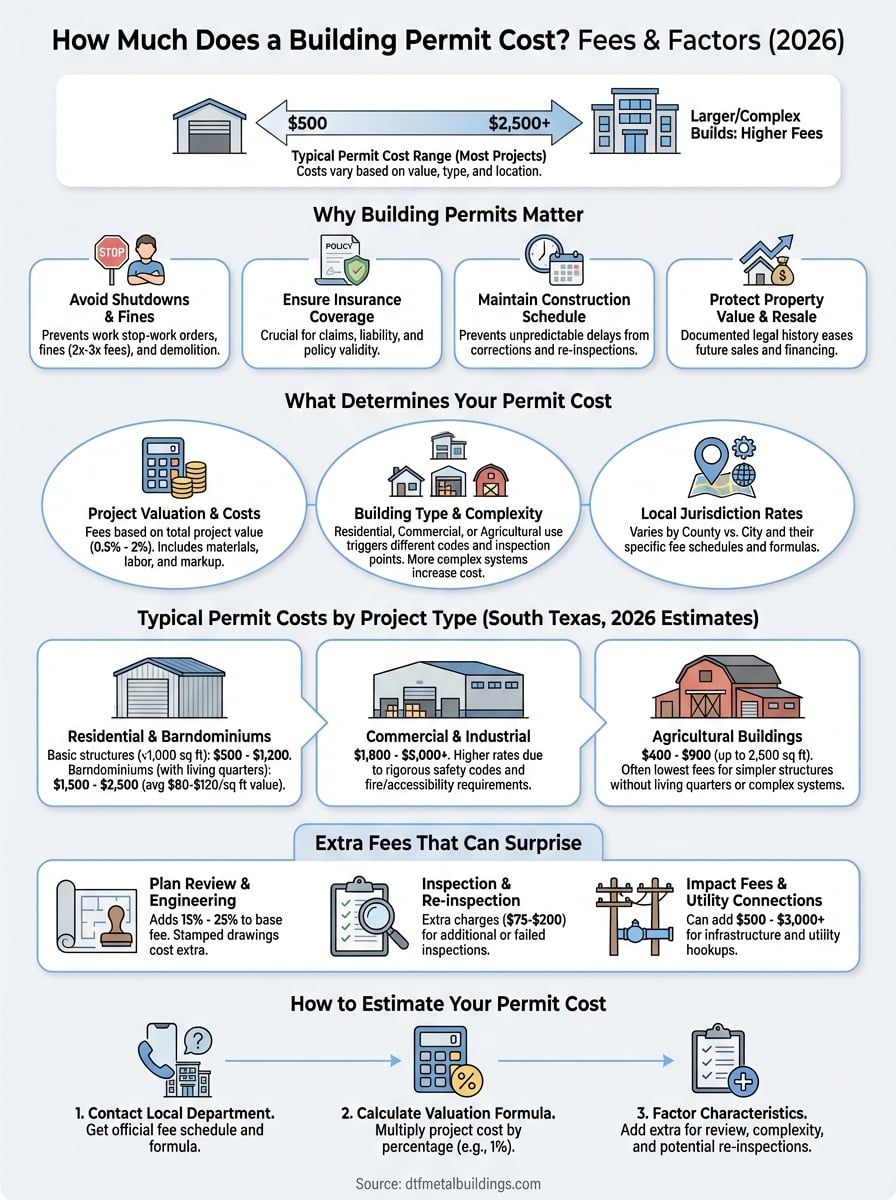
Before you break ground on that new metal workshop, barndominium, or commercial warehouse, there's one cost you can't afford to overlook: the building permit. Understanding how much does a building permit cost helps you avoid budget surprises and keeps your project on track from day one. For most construction projects, permit fees range from $500 to $2,500, though larger or more complex builds can push well beyond that.
At Droptine Metal Buildings, we've guided hundreds of South Texas property owners through the permitting process over the past 15 years. We've seen firsthand how permit costs vary based on project value, building type, and local jurisdiction requirements. Whether you're planning a steel storage building in Medina County or a full-scale commercial structure near San Antonio, knowing what to expect for permit fees helps you plan smarter.
This guide breaks down the factors that influence building permit costs, explains how fees are typically calculated, and gives you practical tools to estimate your own expenses. You'll learn what drives costs up, where you might save, and how to navigate the permitting process without delays eating into your construction timeline.
Why building permits matter for your budget and timeline
You might see permit fees as just another expense, but they protect your investment in ways that save far more than they cost. Building permits ensure your structure meets safety codes, qualifies for proper insurance coverage, and avoids legal issues that could derail your project halfway through construction. When you skip or delay permitting, you risk work stoppages, fines, and even demolition orders that cost exponentially more than the original permit fee.
Protection from costly project shutdowns
Local building departments have the authority to stop unpermitted work immediately when they discover it. You'll face stop-work orders that halt all construction activity until you obtain proper permits and potentially pay penalty fees that double or triple the standard cost. Some jurisdictions charge retroactive permits at 200% to 300% of the normal rate, plus daily fines that accumulate while your project sits idle.
Unpermitted construction discovered mid-project costs property owners an average of 2-3 times more in combined fees, fines, and project delays than simply getting permits upfront.
Property owners in Texas have faced situations where they had to remove completed work that didn't meet code requirements discovered during a belated inspection. The expense of demolition, material replacement, and proper reconstruction far exceeds what you'd spend on permits and proper planning from the start.
Insurance and liability coverage requirements
Your homeowner's or commercial property insurance policy likely includes specific language about permitted construction and code compliance. Building without proper permits can void your coverage if something goes wrong during construction or if you later file a claim related to that structure. Insurance companies routinely deny claims for unpermitted additions, modifications, or new buildings when damage occurs.
Liability protection matters even more during the construction phase. If a worker gets injured on your property while building an unpermitted structure, you may face personal liability without the protection that proper permitting and contractor licensing provides. Licensed contractors working on permitted projects carry insurance that covers these situations.
Impact on your construction schedule
Understanding how much does a building permit cost includes factoring in the time required to obtain approval. Most South Texas jurisdictions process standard building permits within 10 to 20 business days, though complex commercial projects may take longer. You can plan this timeline into your construction schedule rather than facing unexpected delays that push back your completion date and increase carrying costs.
Starting construction before permit approval creates unpredictable timeline disruptions when inspectors require changes to work already completed. Corrections, modifications, and re-inspections add weeks or months to projects that could have progressed smoothly with proper planning.
Long-term value and resale protection
Permitted construction creates a documented building history that protects your property value when you decide to sell. Buyers and their lenders want proof that structures meet code and were built legally. Unpermitted buildings can kill real estate transactions when they surface during title searches or property inspections, forcing you to either obtain retroactive permits or reduce your selling price significantly.
Appraisers often exclude unpermitted structures from property valuations, which means you lose equity on work you've paid for. Banks won't include unpermitted square footage when calculating loan amounts, limiting financing options for potential buyers and reducing your pool of qualified purchasers when selling.
What determines a building permit cost
Understanding how much does a building permit cost starts with knowing that jurisdictions calculate fees using specific formulas based on your project details. No two projects pay identical permit fees because each building brings unique characteristics that affect complexity, risk, and required inspection time. Your final permit cost combines multiple factors that local building departments weigh according to their adopted fee schedules.
Project valuation and construction costs
Most building departments base permit fees on your total project valuation, which includes materials, labor, and contractor profit. You submit a detailed cost estimate when applying for the permit, and officials use this figure to calculate fees through either a flat percentage or a tiered sliding scale. Common formulas charge between 0.5% and 2% of total project value, though some jurisdictions use fixed rates for specific project cost ranges.
Permit fees typically represent 0.5% to 2% of your total construction budget, making accurate project valuation essential for budget planning.
Building departments verify your submitted costs against industry standards and may adjust valuations they consider unrealistically low. If you claim a $50,000 metal building costs only $30,000, expect officials to recalculate based on regional construction averages for similar structures. This verification protects jurisdictions from fee avoidance and ensures consistent treatment across applications.
Building type and structural complexity
Simple structures like storage sheds generate lower permit costs than complex builds requiring multiple inspections. Your metal building's intended use affects permit fees because residential, commercial, and agricultural classifications trigger different code requirements. A 2,000-square-foot metal workshop faces different inspection schedules than a similarly sized retail building, even when construction methods remain nearly identical.
Structural complexity adds permit costs through additional plan review time and specialized inspections. Buildings with custom engineering, complex electrical systems, or plumbing installations require more extensive review than basic post-frame structures. Each additional building system adds inspection points that increase your overall permitting expense.
Local jurisdiction rates and formulas
Your building location determines which fee schedule applies to your project. County permits often cost less than city permits for identical buildings because municipalities maintain larger building departments with more overhead. Some Texas counties charge flat fees based on square footage while others use percentage-based calculations tied to construction value. Medina County might assess fees differently than adjacent Atascosa County even though they share borders and similar construction markets.
Typical permit costs by project type in 2026
Knowing how much does a building permit cost means looking at actual numbers for projects similar to yours. Metal building permits in South Texas typically range from $500 for simple agricultural structures to $3,500+ for large commercial buildings, with most residential projects falling between $800 and $2,000. Your specific costs depend on square footage, intended use, and the complexity of systems like plumbing or specialized electrical work.
Residential metal buildings and barndominiums
Basic residential metal garages and storage buildings under 1,000 square feet typically cost $500 to $1,200 in permit fees across most South Texas counties. Barndominiums and metal homes with living quarters require more extensive permitting because they include plumbing, HVAC, and full electrical systems, pushing permit costs to $1,500 to $2,500 for structures between 1,500 and 2,500 square feet. Counties assess these fees based on construction value, which averages $80 to $120 per square foot for finished metal living spaces.
Residential permits also depend on whether you're building new construction or converting an existing metal building. New barndominium construction requires full residential permits including separate inspections for foundation, framing, mechanical systems, and final occupancy. Conversion projects may qualify for reduced fees if the existing structure already has an approved foundation and framing.
Commercial and industrial structures
Commercial metal buildings face higher permit costs ranging from $1,800 to $5,000+ depending on size and business type. A 3,000-square-foot metal workshop used for commercial manufacturing carries different requirements than a retail storefront of equal size. Building departments assess commercial permits at higher rates because these structures require more rigorous code compliance for fire safety, accessibility, and occupancy loads.
Commercial metal building permits cost 40% to 60% more than residential permits for similar square footage due to enhanced safety requirements and longer inspection schedules.
Industrial warehouses exceeding 5,000 square feet often require specialized engineering reviews that add $500 to $1,500 to base permit costs. Your final fees depend on whether you install specialized systems like overhead cranes, heavy electrical service, or fire suppression equipment.
Agricultural buildings and workshops
Agricultural metal buildings qualify for the lowest permit fees in most Texas jurisdictions, typically $400 to $900 for structures up to 2,500 square feet. Counties recognize that farm buildings without living quarters or complex systems need simpler review processes and fewer inspections. Pole barns, equipment storage buildings, and livestock shelters fall into this category when they lack permanent plumbing or full electrical installations.
Extra fees that can surprise homeowners and builders
Beyond the base permit fee, your total permitting cost includes additional charges that many property owners overlook during initial budget planning. These extra expenses can add $300 to $2,000+ to your project costs depending on your building's complexity and location. Understanding how much does a building permit cost means accounting for these hidden fees before you submit your application rather than scrambling to cover unexpected expenses mid-project.
Plan review and engineering fees
Building departments charge separate fees for reviewing your construction plans and engineered drawings, which typically range from $150 to $800 depending on project complexity. Simple metal buildings with standard designs require minimal review time, while custom structures with unique engineering solutions need extensive examination by licensed plan reviewers. Some jurisdictions calculate these fees as a percentage of your base permit cost, usually adding 15% to 25% to your total expense.
Plan review fees typically add 15% to 25% to your base permit cost, with complex commercial projects requiring the highest review time and expense.
Structural engineering approval adds another layer of cost when your metal building requires stamped drawings from a licensed professional engineer. You pay the engineer directly for design work, which costs $500 to $2,500 for most metal building projects, plus the building department's plan review fee for evaluating those engineered documents.
Inspection and re-inspection charges
Your initial permit fee covers a standard number of required inspections, typically three to five depending on building type. Additional inspections beyond this baseline trigger extra charges of $75 to $200 per visit, which quickly accumulate if your contractor misses scheduled appointments or fails initial inspections. Electrical, plumbing, and mechanical systems each require separate inspections that some jurisdictions bill as add-on fees rather than including them in your base permit cost.
Failed inspections create the most expensive surprise charges because re-inspection fees often double the original inspection cost. When your contractor needs to correct work and request another inspection, you pay $150 to $400 for each return visit depending on your local fee schedule.
Impact fees and utility connections
Some Texas municipalities assess impact fees that fund infrastructure improvements supporting new construction, adding $500 to $3,000 to your permitting costs. These fees cover roads, water systems, and emergency services capacity, with amounts varying based on your building's size and intended use. Rural areas typically skip impact fees, but developments near growing urban centers face the highest charges.
Utility connection permits add separate costs when your metal building requires new water, sewer, or electrical service. Each utility connection carries its own permit fee ranging from $100 to $500, plus inspection charges that stack on top of your building permit expenses.
How to estimate your permit cost for your project
Figuring out how much does a building permit cost for your specific project starts with gathering the right information before you submit your application. You need three key data points: your local jurisdiction's fee schedule, your total construction value, and your building's classification. Armed with these details, you can calculate a realistic permit budget that prevents financial surprises when you're ready to break ground on your metal building project.
Contact your local building department first
Your county or city building department publishes fee schedules that outline exact costs for different project types. Most South Texas jurisdictions post these schedules online, but calling directly gets you the most current rates and clarifies any questions about your specific building. Ask the permitting clerk which formula applies to your project category since agricultural, residential, and commercial classifications follow different calculation methods even when building size remains identical.
Building departments also provide information about additional fees beyond the base permit cost during your initial contact. You'll learn about plan review charges, required inspection counts, and any impact fees that apply to your property location before investing time in a formal application.
Local building departments offer free pre-application consultations that help you understand exact permit costs and requirements before you spend money on engineered plans or contractor deposits.
Calculate based on project valuation formula
Most jurisdictions charge permit fees as a percentage of your total construction value, typically between 0.5% and 2%. Multiply your estimated project cost by this percentage to get your baseline permit fee. For a $75,000 metal building in a jurisdiction charging 1%, you'll pay $750 in base permit fees before adding plan review and inspection charges.
Construction value includes all materials, labor, and contractor markup for your completed structure. Don't underestimate these costs since building officials verify valuations against regional construction standards and may adjust unrealistically low figures upward.
Factor in your building's specific characteristics
Add 15% to 25% to your calculated base fee to cover plan review charges that most jurisdictions assess separately. Buildings requiring engineered drawings, complex electrical systems, or commercial fire safety features push your total higher than simple agricultural structures. Account for inspection fees beyond the standard set if your project timeline or construction methods require additional site visits from building officials.
Quick answers to common permit cost questions
Property owners ask the same questions when planning their metal building projects and trying to budget for permitting expenses. You face real decisions about timing, costs, and compliance that affect your construction schedule and final budget. These answers address the most frequent concerns we hear from South Texas builders and help you understand how much does a building permit cost in specific situations.
Do I need a permit for a small metal building?
Most Texas counties require permits for any structure exceeding 200 square feet or anything with a permanent foundation, regardless of size. Your 10x12 storage shed might skip permitting requirements, but that 16x20 workshop needs approval even without electrical or plumbing systems. Agricultural buildings on rural property sometimes qualify for exemptions when used exclusively for farming operations, though you still need confirmation from your local building department before starting construction.
Structures under 200 square feet without permanent foundations typically avoid permit requirements in most Texas counties, but always verify with your specific jurisdiction before building.
Can I get a refund if my permit expires?
Building departments rarely refund expired permit fees because they've already invested staff time reviewing your plans and processing your application. Most jurisdictions allow permit renewals for 50% to 75% of the original fee when you request extensions before expiration. You lose your entire investment when permits expire without renewal requests, forcing you to reapply and pay full fees again if you still want to build.
How long does it take to get a building permit?
Standard metal building permits take 10 to 20 business days for approval in most South Texas counties, while complex commercial projects requiring detailed engineering review extend to 30 or 45 days. You speed up the process by submitting complete applications with all required documents, engineered drawings, and accurate project valuations the first time. Incomplete applications restart the review clock from zero when you provide missing information.
What happens if I build without a permit?
Building officials issue stop-work orders immediately when they discover unpermitted construction, halting all activity until you obtain proper permits. You face penalty fees ranging from double to triple standard permit costs plus daily fines that accumulate during the correction period. Insurance companies may deny coverage for unpermitted structures, and you'll struggle to sell your property when buyers discover code violations during title searches or inspections.
Final takeaways
Planning your metal building project means understanding how much does a building permit cost before you break ground. Expect to pay $500 to $2,500 for most residential and agricultural metal buildings in South Texas, with commercial structures pushing higher depending on size and complexity. Your total expense includes base permit fees, plan review charges, inspection costs, and potentially impact fees that vary by jurisdiction.
Budget an extra 20% to 30% beyond your base permit estimate to cover unexpected fees and re-inspections. Contact your local building department early in the planning phase to get exact fee schedules and avoid timeline surprises that delay construction. Proper permitting protects your investment through code compliance, insurance coverage, and maintained property value when you eventually sell.
Droptine Metal Buildings handles the construction side of your project with 15 years of South Texas experience. Contact us for a free quote on your metal building and let our team guide you through both construction and permitting requirements from start to finish.