Pole Barn vs Metal Building: Which Is the Better Choice for Your Texas Property?
· By DTF Metal Buildings · Metal Buildings
Introduction
When you need covered space for equipment, livestock, vehicles, or a workshop on your South Texas property, the first decision is usually: pole barn or metal building? Both are popular in Medina, Atascosa, Frio, Bexar, and Wilson counties, but they differ sharply in cost, durability, maintenance, and long-term value.
At DTF Metal Buildings & Fencing, we design, fabricate, and install custom metal buildings for homeowners, ranchers, and commercial clients across the Natalia area. We also build steel and ornamental fencing to match. This guide compares pole barns and metal buildings side-by-side so you can choose the right structure for your land, budget, and goals.
What Is a Pole Barn?
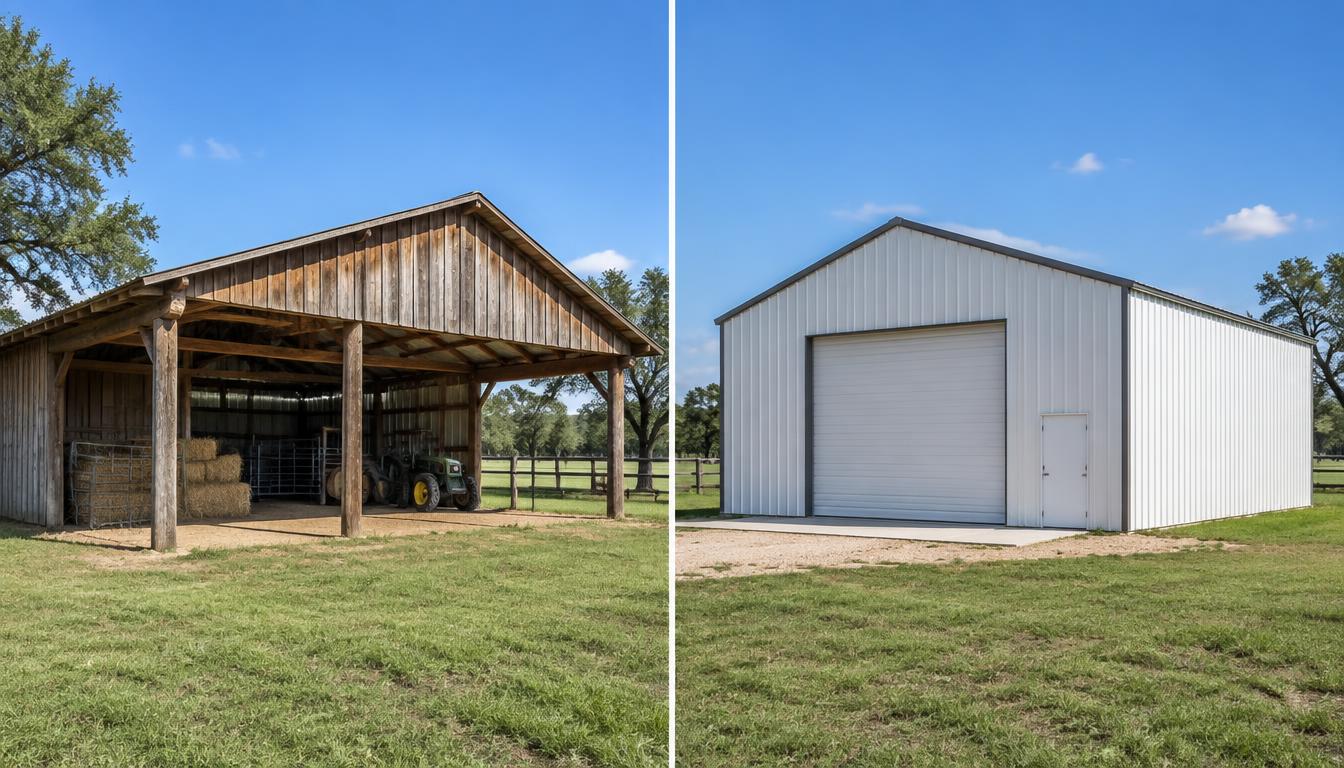
A pole barn is a post-frame building. Vertical wooden posts or laminated columns are buried in the ground or set in concrete footings. The roof trusses and wall girts attach directly to those posts, and the exterior is typically sheet metal, wood siding, or a combination.
Pole barns originated as agricultural buildings because they are fast and inexpensive to erect. They work well for open storage, hay barns, horse stalls, and basic equipment shelters. Because the posts carry the load, pole barns do not always require a full concrete slab, which can lower upfront cost.
Common pole barn uses include:
- Hay and feed storage
- Livestock shelters and horse barns
- Basic equipment cover
- Hobby shops with minimal insulation
What Is a Metal Building?
A metal building is a steel-frame structure. Red iron or tube-steel rigid frames bolt to a concrete foundation. The frame supports the roof and walls, which are typically roll-formed steel panels. Because the frame is steel, metal buildings can span much wider distances without interior columns.
Metal buildings are engineered to local wind and load codes. They can be insulated, finished, and customized with windows, walk doors, roll-up doors, skylights, and wainscoting. They are the standard choice for commercial steel buildings, barndominiums, workshops, and equipment barns that need to last decades.
Common metal building uses include:
- Residential workshops and garages
- Barndominiums and homes
- Commercial warehouses and retail space
- Agricultural equipment and feed storage
- Airplane hangars and RV covers
Pole Barn vs Metal Building: Cost Comparison
Upfront cost is often the deciding factor. Pole barns usually cost less to build per square foot because they use fewer materials and can sit on dirt or gravel floors. Metal buildings require a concrete slab, engineered steel, and more labor, which raises initial price.
However, the lifetime cost picture often flips. Wood posts are vulnerable to rot, termites, and ground moisture. Over 15 to 30 years, pole barn owners may face:
- Post replacement or sistering
- Siding and roof panel replacement
- Pest treatment and wood repair
- Re-leveling as posts settle
Steel frames do not rot or attract termites. Galvanized panels resist rust for decades. A well-built metal building typically requires far less maintenance, which can make it the lower-cost option over its full life.
Bottom line: If you need the cheapest possible shelter for a few years, a pole barn may win. If you want a permanent structure that holds value, a metal building is usually the smarter investment.
Durability and Weather Resistance in South Texas
South Texas weather is tough on buildings. High heat, intense UV, sudden hail, strong winds, and occasional flooding all test a structure. Metal buildings are engineered for these conditions. Steel frames do not warp, twist, or rot. Galvalume or painted steel panels reflect heat and stand up to hail better than wood or thin agricultural siding.
Pole barns rely on wood posts in contact with soil. In clay-heavy South Texas soil, moisture can wick into the posts and cause decay. Termites are also active across the region. Even pressure-treated lumber will eventually degrade where it meets the ground.
Wind rating is another key difference. Engineered metal buildings can be designed to 120 mph or higher wind loads. Pole barns vary widely depending on who built them and how deeply the posts are set.
Construction Timeline
Pole barns can go up quickly because the foundation work is minimal. A small pole barn may be enclosed in a few days. Metal buildings take more site prep because the slab must be poured and cured before the frame is erected. A typical metal building timeline runs:
- Site prep and grading: 1–3 days
- Concrete slab pour and cure: 7–14 days
- Steel delivery and frame erection: 3–7 days
- Paneling, trim, doors, and insulation: 3–7 days
At DTF Metal Buildings, we handle the full process from pad prep to final walkthrough. We also coordinate permits when required, so you are not left managing multiple contractors.
Customization and Design Options
Metal buildings offer far more design flexibility. Clear-span widths up to 100 feet or more are possible without interior columns. You can add:
- Lean-tos and awnings
- Mezzanines and second floors
- Roll-up doors, walk doors, and windows
- Insulation packages, including spray foam
- Interior finish-out for barndominiums
- Wainscoting, soffits, and gutters
Pole barns are more limited. Wide spans require interior posts, which reduce usable floor space. Finish-out options are also more restricted because the wood frame is not as uniform or as strong as a steel frame.
If you are considering a barndominium or shop-house, a metal building is almost always the better starting point.
Maintenance Requirements
Metal buildings need very little maintenance. Annual tasks usually include:
- Clearing gutters and downspouts
- Inspecting caulk and trim
- Washing panels if dirt or mildew accumulates
- Checking door and window seals
Pole barns require more attention. Wood posts, siding, and trim need regular inspection for rot, insect damage, and warping. Roof leaks are more common as the structure settles over time. If the building houses livestock, moisture and ammonia accelerate wood deterioration.
Which Is Better for Your South Texas Property?
Choose a pole barn if you need:
- The lowest possible upfront cost
- Temporary or seasonal shelter
- A simple agricultural building without insulation
- A structure you may replace in 10–15 years
Choose a metal building if you want:
- A permanent structure that adds property value
- Wide clear-span space without interior posts
- Better protection from wind, hail, and fire
- Lower lifetime maintenance
- Insulated, finished, or climate-controlled space
- A barndominium, workshop, or commercial facility
Frequently Asked Questions
Is a metal building cheaper than a pole barn?
Not usually upfront. Metal buildings typically cost more to build because of the concrete slab and engineered steel. Over the life of the building, however, lower maintenance and longer lifespan often make metal buildings the more economical choice.
Do metal buildings last longer than pole barns?
Yes. A properly maintained metal building can last 40 to 60 years or more. Pole barns often need major repairs or replacement within 20 to 30 years due to wood rot, insect damage, and settling.
Can a metal building be used as a house?
Yes. Metal buildings are commonly converted into barndominiums and shop-homes. The steel frame supports interior walls, plumbing, electrical, and insulation just like a traditional home.
Do I need a permit for a pole barn or metal building in Texas?
Permit requirements vary by county and city. Rural areas may have fewer restrictions, but most incorporated cities require permits based on size and use. DTF Metal Buildings can help you determine what permits are needed for your specific location.
Conclusion
Both pole barns and metal buildings have their place on Texas properties. If you need a quick, low-cost shelter, a pole barn can work. If you want a durable, low-maintenance structure that protects your investment for decades, a custom metal building is the better choice.
DTF Metal Buildings & Fencing serves Natalia, Lytle, Devine, LaCoste, Bigfoot, Somerset, Castroville, Hondo, and the surrounding areas. We offer free quotes, 24-hour response times, and a 100% satisfaction guarantee on our work.