Spray Foam Insulation Cost Per Square Foot: 2026 Prices
· By DTF Metal Buildings · Tips & Guides
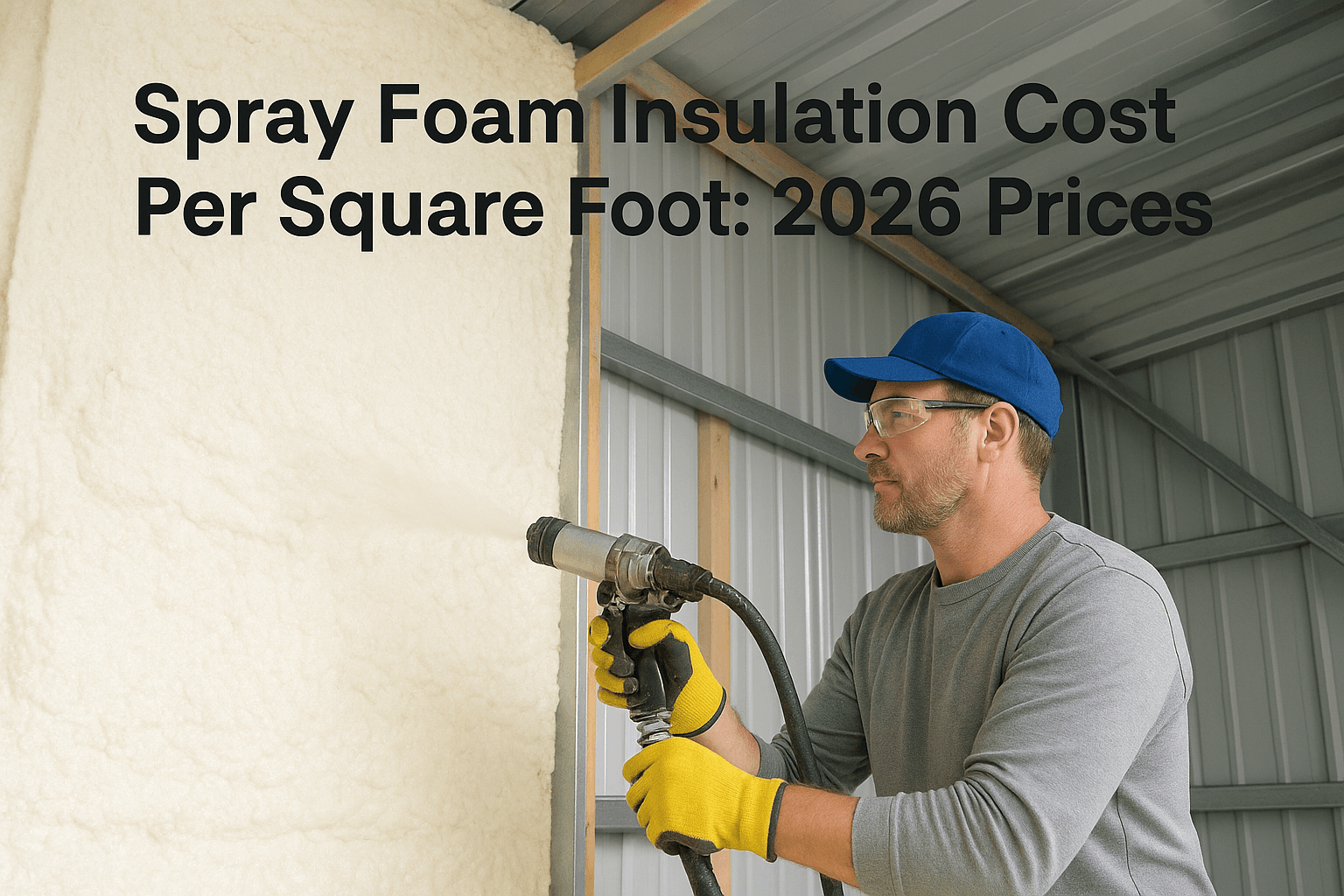
Spray Foam Insulation Cost Per Square Foot: 2026 Prices
Metal buildings and steel structures perform best when paired with proper insulation, and spray foam has become the go-to choice for South Texas property owners who want maximum energy efficiency. But before you commit to a project, you need real numbers. Understanding spray foam insulation cost per square foot helps you budget accurately and avoid surprises when quotes start rolling in. In 2026, prices have shifted due to material costs and labor demand, so outdated estimates won't cut it when planning your build.
The price gap between open-cell and closed-cell foam can significantly impact your total investment. Open-cell runs cheaper upfront but offers different performance characteristics than its denser counterpart. Closed-cell foam costs more per square foot but delivers superior R-value and moisture resistance, critical factors for metal buildings exposed to South Texas heat and humidity. Knowing which type fits your structure and budget is half the battle.
At Droptine Metal Buildings, we've seen firsthand how insulation choices affect the long-term performance of steel structures. Our sister company handles professional spray foam installation for the metal buildings we construct, giving us direct insight into current pricing and project requirements. This guide breaks down 2026 costs, compares foam types, and explains what drives pricing so you can make an informed decision for your workshop, barndominium, or commercial building.
Why spray foam cost per square foot varies
The spray foam insulation cost per square foot swings wildly based on factors that go beyond just the foam itself. Material selection represents the first major cost driver, but your final bill depends on a combination of variables including labor availability, building complexity, and project size. South Texas contractors typically quote anywhere from $1.20 to $4.50 per square foot, and understanding what pushes prices to either extreme saves you from budget shock when estimates arrive.
Material type and density differences
Open-cell foam costs less because manufacturers produce it at lower density (around 0.5 pounds per cubic foot) and it requires less raw material per application. Closed-cell foam packs roughly 1.8 to 2.0 pounds per cubic foot and demands more polyurethane components, which directly translates to higher per-square-foot pricing. The chemical formulation differs between the two types, affecting not just the purchase price but also the equipment needed for proper application.
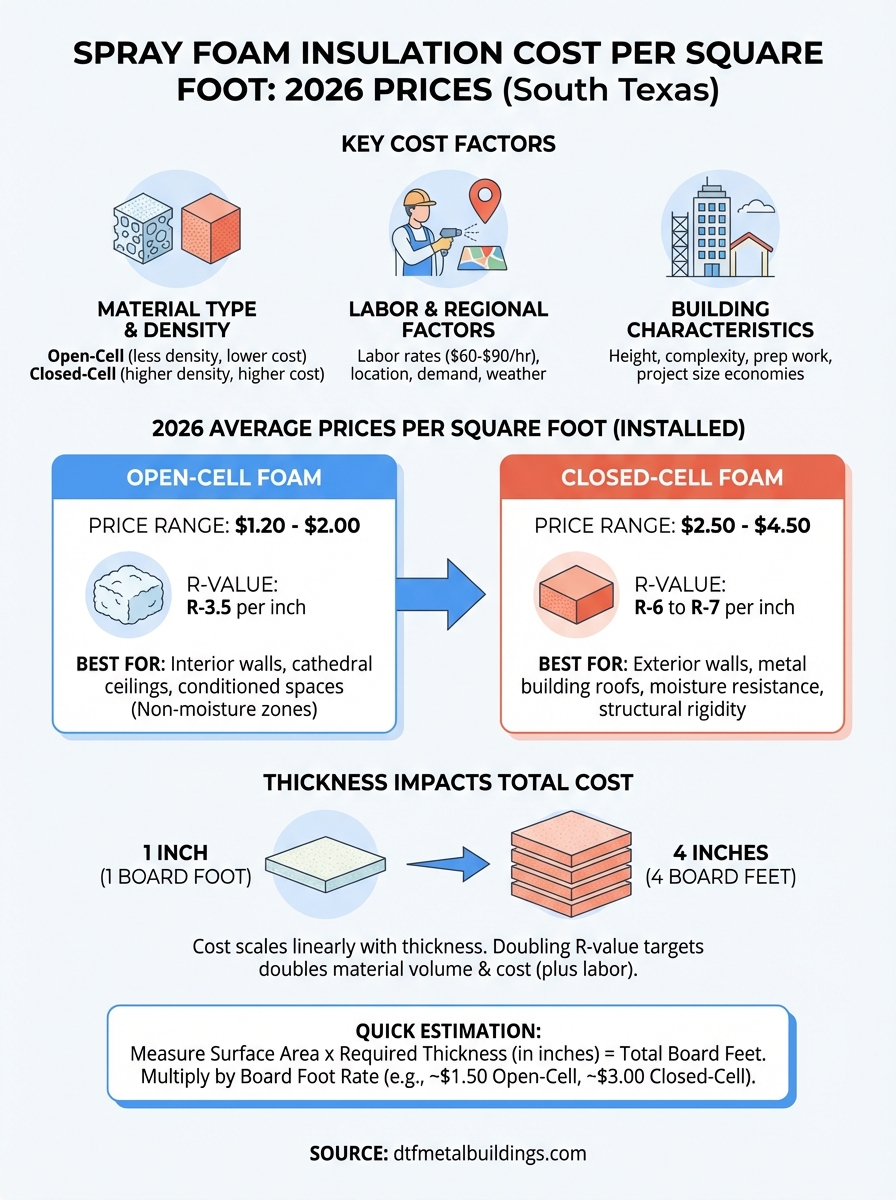
Your choice between these materials changes costs by roughly 40% to 60% on average. Closed-cell foam delivers an R-value of 6 to 7 per inch while open-cell provides about 3.5 per inch, meaning you might need double the thickness of open-cell to match closed-cell performance. Thickness requirements multiply the base cost since installers charge per board foot (one square foot at one inch thick), not just square footage alone.
Labor rates and regional market factors
Installation complexity drives labor costs more than most property owners expect. Certified spray foam applicators charge premium rates because the work requires specialized training, protective equipment, and careful environmental controls during application. South Texas sees hourly labor rates between $60 and $90 for qualified teams, and these rates climb during peak construction seasons when demand outpaces available crews.
Regional supply chain dynamics affect material costs separate from labor, with some areas experiencing 15% to 25% price premiums during high-demand periods.
Distance from major suppliers adds freight charges to your project. Remote ranch locations or properties beyond the I-35 corridor often face delivery surcharges that contractors pass along in per-square-foot pricing. Weather conditions also play a role since spray foam requires specific temperature ranges for proper curing, forcing contractors to schedule around South Texas heat waves or rare cold snaps.
Building characteristics that drive up costs
Height and accessibility create pricing variations most people overlook. Projects requiring scaffolding or lift equipment add $200 to $500 in daily equipment rental costs that get distributed across your total square footage. Metal buildings with cathedral ceilings or complex rooflines demand more setup time and careful application angles, pushing the per-square-foot price upward even when using identical foam products.
Surface preparation requirements affect quotes significantly. Steel panels need thorough cleaning and sometimes rust treatment before foam application, adding labor hours to the baseline estimate. Buildings with existing insulation require removal and disposal, tacking on disposal fees and extra work hours. Irregular framing patterns or numerous penetrations (vents, electrical boxes, plumbing) slow down application rates and reduce the efficiency that keeps costs down on straightforward projects.
Project size influences per-square-foot pricing through economies of scale. Smaller jobs under 1,000 square feet typically cost more per unit because setup time and minimum crew charges don't vary much regardless of project size. Larger commercial buildings or multiple structures done simultaneously bring costs down as efficiency improves and material purchases qualify for bulk pricing from distributors.
2026 average prices for open-cell and closed-cell
Current market data from South Texas contractors shows spray foam insulation cost per square foot has stabilized after the volatility of 2024 and 2025. Open-cell foam now runs between $1.20 and $2.00 per square foot for standard residential applications, while closed-cell foam ranges from $2.50 to $4.50 per square foot depending on thickness requirements and project specifics. These prices reflect fully installed costs including labor, equipment, and surface preparation for typical metal building applications.
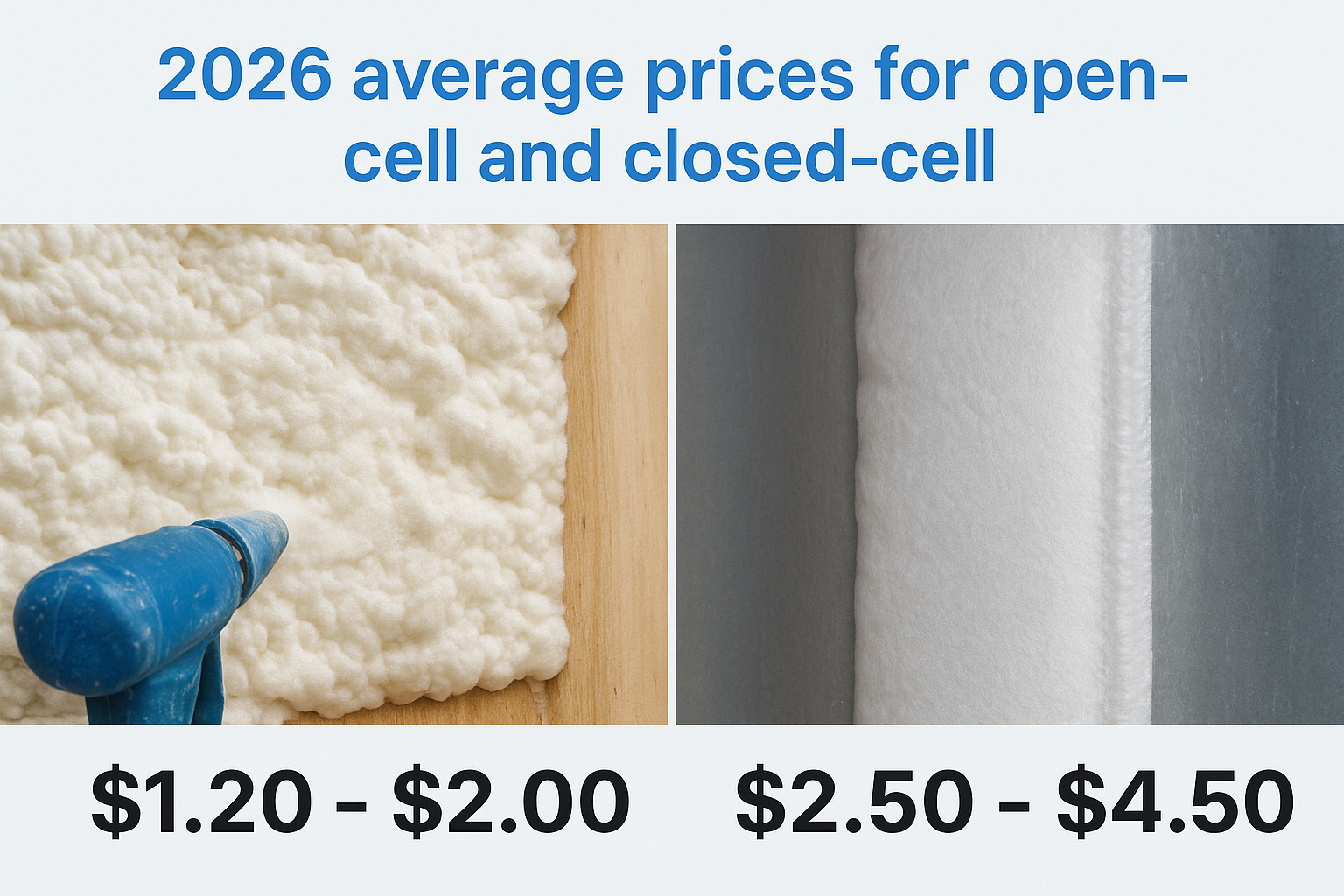
Open-cell foam current pricing
Open-cell spray foam sits at the budget-friendly end of the spectrum but still delivers solid insulation performance for many South Texas structures. Professional installation averages $1.50 per square foot for a 3.5-inch application that achieves R-13, the minimum code requirement for many residential spaces. Your final cost drops closer to $1.20 per square foot on larger projects exceeding 3,000 square feet where efficiency gains benefit your bottom line.
Projects requiring thicker applications to reach R-19 or R-21 push pricing toward $1.80 to $2.00 per square foot since you're paying for additional material and application time. Open-cell foam works well for interior walls, cathedral ceilings in conditioned spaces, and areas where moisture intrusion isn't a primary concern. The lower density means you get less structural reinforcement compared to closed-cell alternatives.
Contractors typically quote open-cell projects at roughly 50% to 60% less than equivalent closed-cell installations when comparing the same R-value targets.
Closed-cell foam current pricing
Closed-cell foam commands premium pricing because the material delivers R-6 to R-7 per inch and provides moisture barriers critical for metal building exteriors. Standard 2-inch applications that achieve R-12 to R-14 cost $2.50 to $3.20 per square foot in South Texas markets. Your price climbs to $3.50 to $4.50 per square foot when specifications require 3 to 4 inches of thickness for R-21 to R-28 performance.
Metal shop owners and commercial operators often choose closed-cell foam despite the higher upfront cost because the product adds structural rigidity to steel panels and creates an impermeable vapor barrier. This matters significantly in humid South Texas conditions where moisture management prevents rust and mold issues. Projects in coastal areas or regions with high water tables see the most benefit from closed-cell applications.
Bulk pricing breaks appear around 5,000 square feet where contractors negotiate better material costs and spread equipment mobilization across larger applications. Your per-square-foot price might drop 15% to 20% on substantial commercial buildings or multiple structures tackled in a single contract period.
How thickness and R-value targets affect pricing
The relationship between insulation thickness and your final bill follows a simple rule: every additional inch of foam adds roughly the same incremental cost to your per-square-foot pricing. Contractors price spray foam insulation by the board foot, which measures one square foot at one inch thick. When you specify a target R-value that requires 4 inches instead of 2 inches, you're essentially doubling your material and application costs since the crew applies twice as much product to the same surface area.
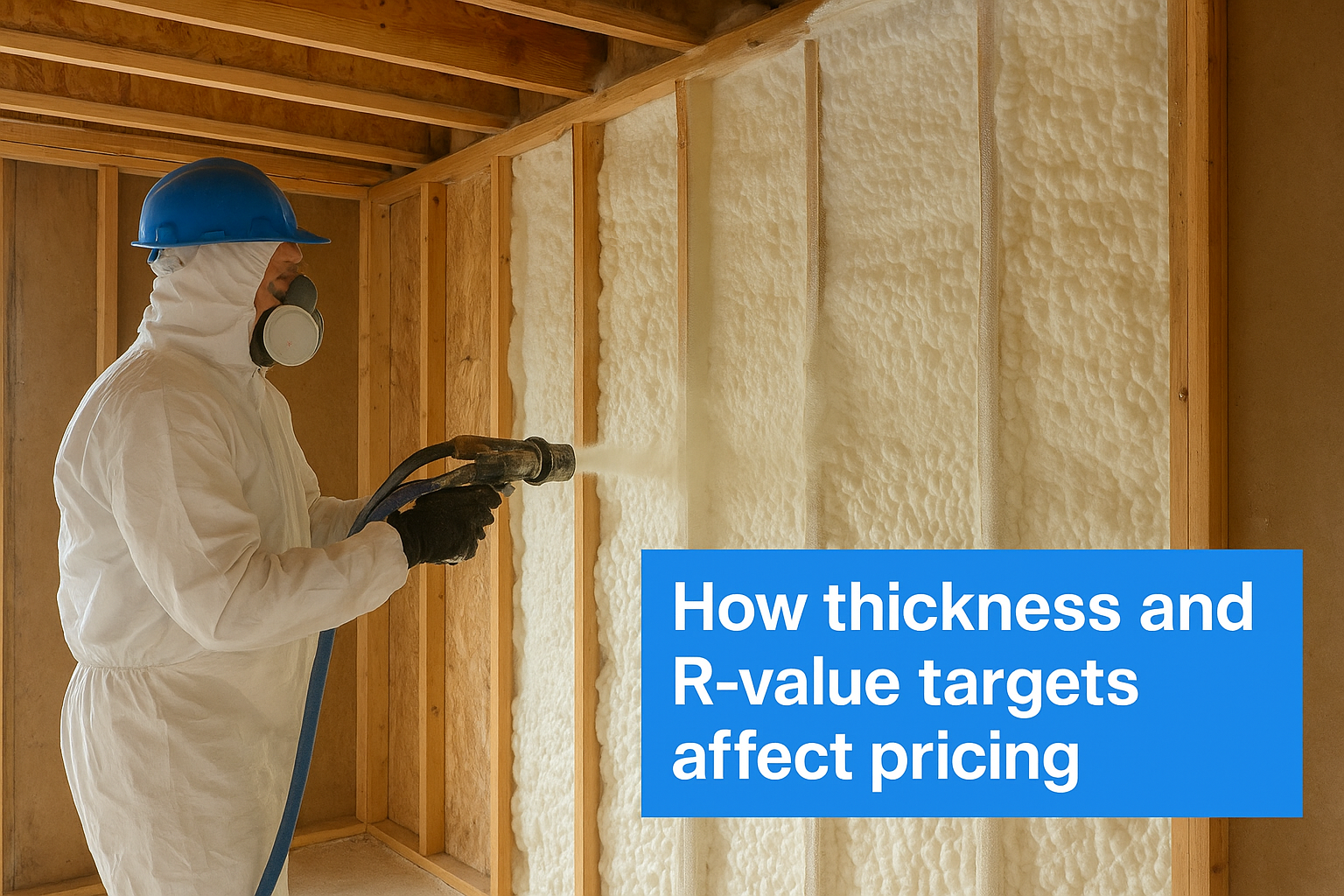
R-value requirements and code compliance
South Texas building codes typically mandate minimum R-13 for walls and R-19 for ceilings in residential structures, though commercial buildings face different standards depending on use classification. Your spray foam insulation cost per square foot scales directly with these requirements since achieving higher R-values demands thicker applications. Open-cell foam needs roughly 3.5 inches to hit R-13, while closed-cell requires only 2 inches for the same thermal performance.
Energy efficiency goals beyond minimum code drive many property owners to specify R-21 or R-30 for metal building roofs exposed to intense Texas sun. Reaching R-30 with closed-cell foam requires 5 inches of thickness, translating to five board feet per square foot. Your pricing multiplies accordingly since you're paying for five times the material volume compared to a 1-inch application.
Calculating thickness needs for different R-values
Open-cell foam delivers approximately 3.5 R-value per inch, so reaching R-21 requires 6 inches of application thickness. Closed-cell foam provides R-6 to R-7 per inch, meaning you need only 3 to 3.5 inches to achieve the same thermal resistance. The math looks straightforward but impacts your budget significantly when applied across hundreds or thousands of square feet.
Doubling the thickness from code minimum to high-performance specifications typically increases your total insulation investment by 80% to 100% depending on foam type and project complexity.
Roof applications usually require thicker foam than wall installations because heat gain through metal roofing creates the biggest energy load in South Texas buildings. Budget-conscious builders sometimes specify closed-cell foam for roofs at 3 to 4 inches while using open-cell foam at 3.5 inches for walls, balancing performance against cost constraints.
Cost multiplication beyond minimum thickness
Your per-square-foot price doesn't just double when you double thickness because labor efficiency improves slightly when crews apply thicker coats in fewer passes. A 4-inch closed-cell application might cost $3.80 per square foot while a 2-inch application runs $2.50, showing the incremental cost per additional inch decreases modestly. Material costs remain consistent per board foot, but application time per square foot drops as technicians develop rhythm on continuous thick applications.
Square feet vs board feet and what bids include
The confusion between square feet and board feet causes more pricing misunderstandings than any other aspect of spray foam projects. When contractors quote spray foam insulation cost per square foot, they're actually pricing by board feet, which measures volume rather than just surface area. One board foot equals one square foot at one inch thick, so a 500-square-foot ceiling requiring 3 inches of foam actually needs 1,500 board feet of material. Your quote multiplies the board foot rate by total thickness, not just the floor area you're covering.
Understanding the board foot pricing model
Contractors calculate your total cost by measuring the surface area in square feet and multiplying by the required thickness in inches. A metal shop with 2,000 square feet of wall space needing 2 inches of closed-cell foam requires 4,000 board feet of product. If the contractor charges $2.50 per board foot, your wall insulation runs $10,000 before adding roof sections or other areas.
This pricing structure explains why thickness dramatically affects your total investment even when the per-board-foot rate stays constant. You pay for volume, not just coverage area. Some contractors quote by the square foot but specify thickness separately, which creates the same calculation with different terminology. Always clarify whether quotes reflect board feet or square feet and confirm the assumed thickness to avoid budget surprises.
What professional quotes typically include
Legitimate spray foam bids bundle several cost components into the per-square-foot or board foot pricing. Surface preparation, application labor, and material costs form the core of standard quotes from reputable South Texas contractors. Your bid should clearly specify foam type (open-cell or closed-cell), target R-value, and total square footage with thickness measurements for each building section.
Equipment mobilization, safety measures, and cleanup typically appear as line items or get absorbed into the per-board-foot rate on larger projects. Professional installers include the cost of protective gear, ventilation equipment during application, and removal of overspray or cleanup after curing. Your contract should detail these inclusions to prevent additional charges when work begins.
Detailed bids that break down square footage by building section (walls, roof, rim joists) prevent disputes and ensure everyone understands the scope before application starts.
Hidden costs and common exclusions
Most quotes exclude structural repairs, extensive surface preparation beyond basic cleaning, and access equipment like scaffolding or boom lifts needed for high ceilings. Your metal building might need rust treatment or panel replacement before foam application, adding costs that fall outside the insulation contract. Properties requiring special access arrangements or remote locations often face delivery surcharges not reflected in base per-square-foot pricing.
Permit fees, engineering reviews, and inspection costs rarely appear in insulation quotes since these administrative expenses vary by jurisdiction. South Texas counties and municipalities enforce different requirements, so budget an additional $200 to $800 for permitting on residential projects and more for commercial structures. Contractors sometimes handle permit applications but charge separately for this service.
How to estimate your spray foam cost in 10 minutes
Calculating your project budget before calling contractors gives you negotiating power and prevents quote shock when bids arrive. Quick estimation requires only three measurements and basic multiplication, tools you already have in your metal building or shop. The process takes less time than driving to a supplier for pricing, and you'll walk away with a realistic budget range that accounts for both material and labor costs common in South Texas markets.
Measure your building's insulation surface area
Start by measuring wall height and length for each exterior wall section that needs insulation, then multiply height times length to get square footage per wall. Add up all wall sections to calculate total wall area. Roof or ceiling measurements require length times width for flat or simple gable designs, while complex rooflines need section-by-section calculations that break the surface into manageable rectangles or triangles.
Don't subtract for doors, windows, or small penetrations since contractors typically price the gross area and these subtractions create more measurement disputes than savings. Your metal building's square footage adds up quickly, a 40x60 shop with 14-foot walls has 3,360 square feet of wall space plus 2,400 square feet of ceiling, totaling 5,760 square feet before accounting for thickness.
Choose your foam type and target thickness
Pick between open-cell and closed-cell foam based on your moisture concerns and budget constraints, then determine required thickness to meet your R-value goals. Standard residential builds use 3.5 inches of open-cell (R-13) for walls or 2 inches of closed-cell (R-12 to R-14). Commercial structures or high-performance homes often specify 3 to 4 inches of closed-cell for roofs to combat South Texas heat gain.
Your thickness selection directly multiplies your square footage into board feet, so a 2,000-square-foot ceiling needing 3 inches requires 6,000 board feet of material and labor.
Calculate board feet by multiplying your total square footage by the thickness in inches. That 5,760-square-foot shop with 2 inches of closed-cell on walls and 3 inches on the ceiling needs 17,280 board feet total (11,520 for walls plus 7,200 for ceiling).
Apply current market rates to your board feet
Use $1.50 per board foot for open-cell foam and $3.00 per board foot for closed-cell as baseline 2026 estimates for South Texas professional installation. Your shop example with closed-cell throughout costs roughly $51,840 at $3.00 per board foot, though actual spray foam insulation cost per square foot quotes might range 20% lower or higher based on project complexity and contractor availability.
Add 10% to 15% for contingency since measurements rarely account for every corner, header, or irregular section. Your $51,840 estimate becomes $57,600 to $59,600 with buffer, giving you a realistic target when comparing professional bids.
Example costs for shops, barns, and garages
Real-world cost scenarios help you visualize what your specific project might run before you commit to calling contractors. Different building types face distinct insulation challenges that affect both material selection and final pricing, so your 30x40 workshop budget looks different from a 60x80 barn even when using identical foam products. These examples use current 2026 South Texas pricing based on professional installation with standard wall heights and simple gable roofs.
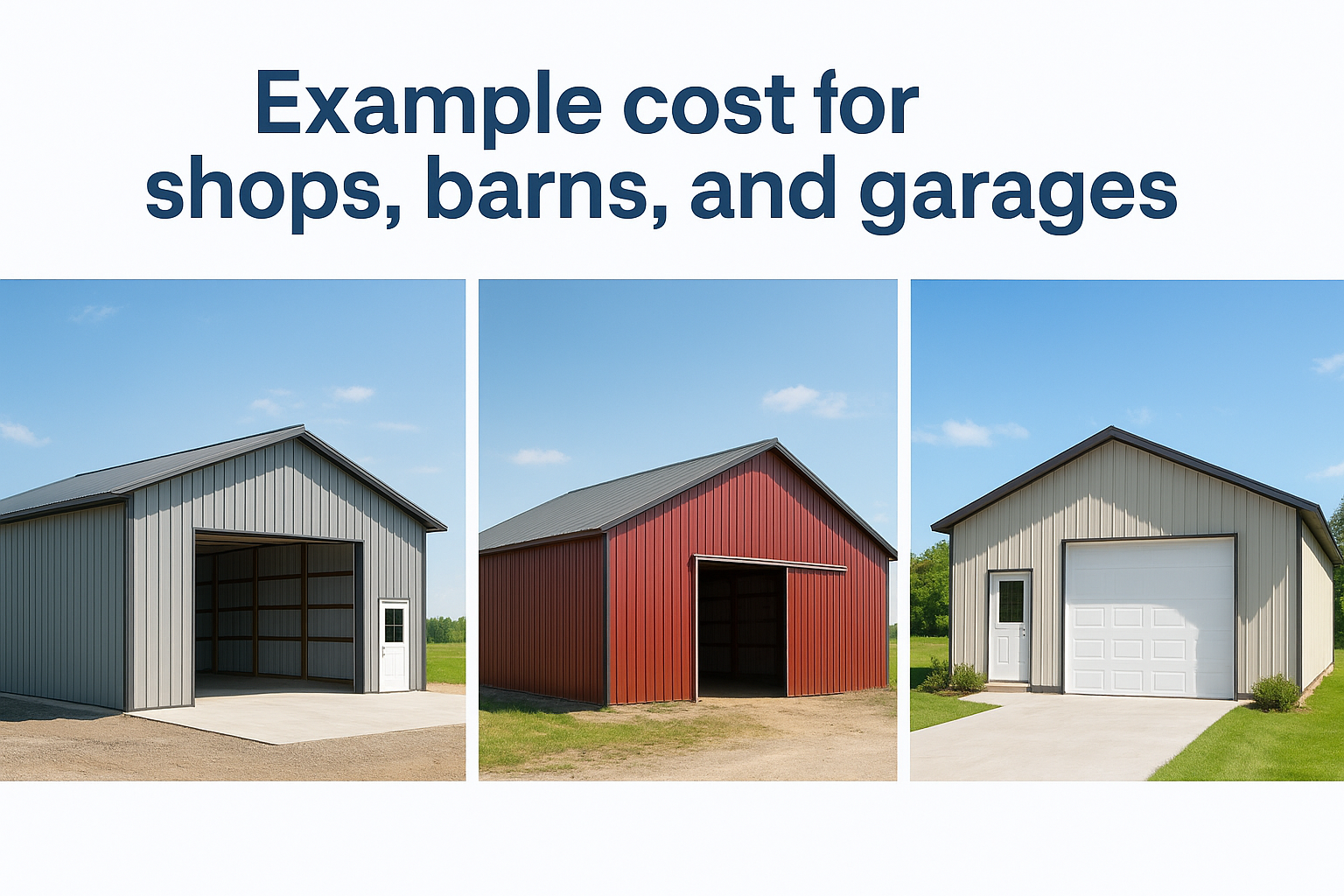
Small to medium metal shops (30x40 to 40x60)
A 30x40 shop with 12-foot walls and a simple gable roof contains roughly 2,880 square feet of insulation surface (1,680 square feet walls plus 1,200 square feet ceiling). Using 2 inches of closed-cell foam on walls and 3 inches on ceiling requires 6,960 board feet total. Your spray foam insulation cost per square foot translates to $20,880 to $24,360 at $3.00 to $3.50 per board foot depending on contractor rates and project specifics.
Stepping up to a 40x60 shop with 14-foot walls increases your surface area to approximately 5,360 square feet (3,360 square feet walls plus 2,400 square feet ceiling). The same thickness specifications require 13,920 board feet and run $41,760 to $48,720 for complete closed-cell coverage. Choosing open-cell foam at 3.5 inches throughout drops costs to roughly $29,000 to $33,600 on the larger shop.
Agricultural barns and equipment storage
Barns present unique challenges because interior space often remains partially conditioned while equipment bays need basic temperature control. A 60x80 barn with 16-foot sidewalls contains about 10,880 square feet of insulation surface before accounting for doors and openings. Hybrid approaches reduce costs by using closed-cell foam at 2 inches on the roof (9,600 board feet) and open-cell at 3.5 inches on walls (10,080 board feet), totaling roughly $43,920 to $51,000.
Property owners frequently save 25% to 35% on barn projects by limiting insulation to specific zones like tack rooms or living quarters rather than conditioning the entire structure.
Full closed-cell coverage at 3 inches on roofs and 2 inches on walls pushes the same 60x80 barn to 34,560 board feet and $103,680 to $121,000. Most agricultural operations choose selective insulation strategies that prioritize critical areas while leaving open storage sections uninsulated.
Residential garages and carports
A standard two-car garage measuring 24x24 with 10-foot walls needs coverage on 1,536 square feet (960 square feet walls plus 576 square feet ceiling). Closed-cell foam at 2 inches on walls and 3 inches overhead requires 3,648 board feet and costs $10,944 to $12,768 for professional installation. Your attached garage benefits from shared walls with conditioned space, potentially reducing the insulation area by 20% to 25%.
Detached garages or workshops under 500 square feet often see higher per-square-foot pricing because setup costs and minimum crew charges don't scale down proportionally. Expect quotes 15% to 20% above the standard board foot rate on compact projects where efficiency gains disappear.
DIY kits vs pro installation: true cost and risk
DIY spray foam kits attract property owners looking to cut costs on metal building insulation projects, but the advertised savings rarely match reality once you factor in equipment needs, material waste, and potential application failures. Manufacturers sell two-component foam kits ranging from $400 to $1,800 depending on coverage area, which appears significantly cheaper than professional installation when you compare raw material costs. Your spray foam insulation cost per square foot drops to roughly $0.80 to $1.20 for DIY materials alone, but this calculation ignores critical expenses and risks that professional contractors absorb.
DIY kit upfront savings and hidden costs
Retail foam kits provide enough material to cover 200 to 600 square feet at recommended thickness, depending on package size and foam type. You pay between $0.80 and $1.50 per board foot for the chemicals compared to $1.50 to $3.00 per board foot for professional installation. Equipment requirements quickly erode these savings since proper application demands respirators ($150 to $300), Tyvek suits ($40 to $80), chemical-resistant gloves, and adequate ventilation setup.
First-time applicators waste 20% to 40% of material through improper mixing ratios, overspray, and uneven application, turning your budget kit into an expensive learning experience. Professional crews achieve consistent coverage because they've completed hundreds of applications, while your first attempt often requires additional kit purchases to fix thin spots or missed sections. Temperature and humidity requirements mean you might rent climate control equipment if conditions fall outside the narrow application window, adding $100 to $300 daily to your DIY project.
Safety risks and application failures
Spray foam chemicals release toxic isocyanates during application that cause respiratory damage, skin sensitization, and long-term health effects without proper protective equipment and ventilation. Licensed contractors carry liability insurance and workers compensation coverage that protects you if someone gets hurt, while your DIY project puts your health and property at risk. Improper mixing or application creates foam that never fully cures, off-gassing chemicals into your building for months and failing to provide the insulation performance you paid for.
DIY foam application errors often require complete removal and professional reapplication, doubling your total project cost compared to hiring qualified installers from the start.
Your warranty coverage disappears with DIY installation since foam manufacturers only guarantee products applied by certified professionals who follow specific protocols. Structural issues from incorrect foam expansion or moisture trapping become your responsibility, potentially costing thousands in repairs.
When DIY makes sense (rarely)
Small touch-up projects under 100 square feet might justify DIY kits if you already own safety equipment and have experience with two-component chemical systems. Filling gaps around pipes or sealing small rim joist sections works for handy property owners willing to invest time in proper preparation and safety protocols. Most metal building projects exceed the practical scope for DIY application, especially when you need consistent coverage across thousands of square feet where quality directly affects long-term energy costs and building performance.
What to do next
Understanding spray foam insulation cost per square foot gives you the foundation to move forward with confidence on your metal building project. Your next step involves getting written quotes from at least three licensed contractors who specialize in metal building applications and can provide references from similar South Texas projects. Request detailed bids that break down square footage, foam type, thickness specifications, and included services so you can compare proposals accurately.
Professional installation protects your investment and ensures your structure performs efficiently for decades. Don't let low-ball estimates tempt you into cutting corners since proper application requires certified equipment, trained crews, and quality materials that meet manufacturer specifications.
Ready to discuss insulation options for your metal building? Contact our team at Droptine Metal Buildings to explore how spray foam pairs with our steel construction services. We provide 24-hour quote responses and can connect you with our sister company for professional insulation installation that matches your building's specific requirements.